I have adopted K. Douglas Goodman as my professional name for all academic writing and publications. Because there are at least three other contemporary Kevin Goodmans in academia—two of whom share similar research interests—as well as a K.D. Goodman, using my first initial and middle name helps ensure my work is properly attributed and differentiated.
My research centers on the mechanics of social influence. Because influence fundamentally relies on communication and signaling, my work utilizes a dual focus on social semiotics and cognitive analysis. However, to understand influence holistically, it must be examined within the constraints of the culture it operates in.
Historically, I have explored this by isolating influence at its extremes: placebos, mass delusions, psychogenic illness, religious ecstasy, economic bubbles, and conspiracy theories. In these instances, collective belief overrides surface-level logic through localized communicative events.
Currently, my focus has shifted to the architecture of social status and legitimacy. While seemingly distinct from psychogenic phenomena, cultural legitimacy is built from the exact same raw materials: communication, signaling, collective belief, and the scaffolding of culture. Just as my master’s thesis framed hypnosis not as a discrete practice but as an act of social compliance, my proposed doctoral research applies this cognitive and sociological framework to commercial markets—specifically analyzing how American craft whiskey brands construct cultural capital and institutional legitimacy.
ORCID: 0009-0004-6312-2993
Abstract of Doctoral Research Proposal
Working Title: The Architecture of Authenticity: The Development of Cultural Capital in the American Craft Whiskey and Bourbon Industry.
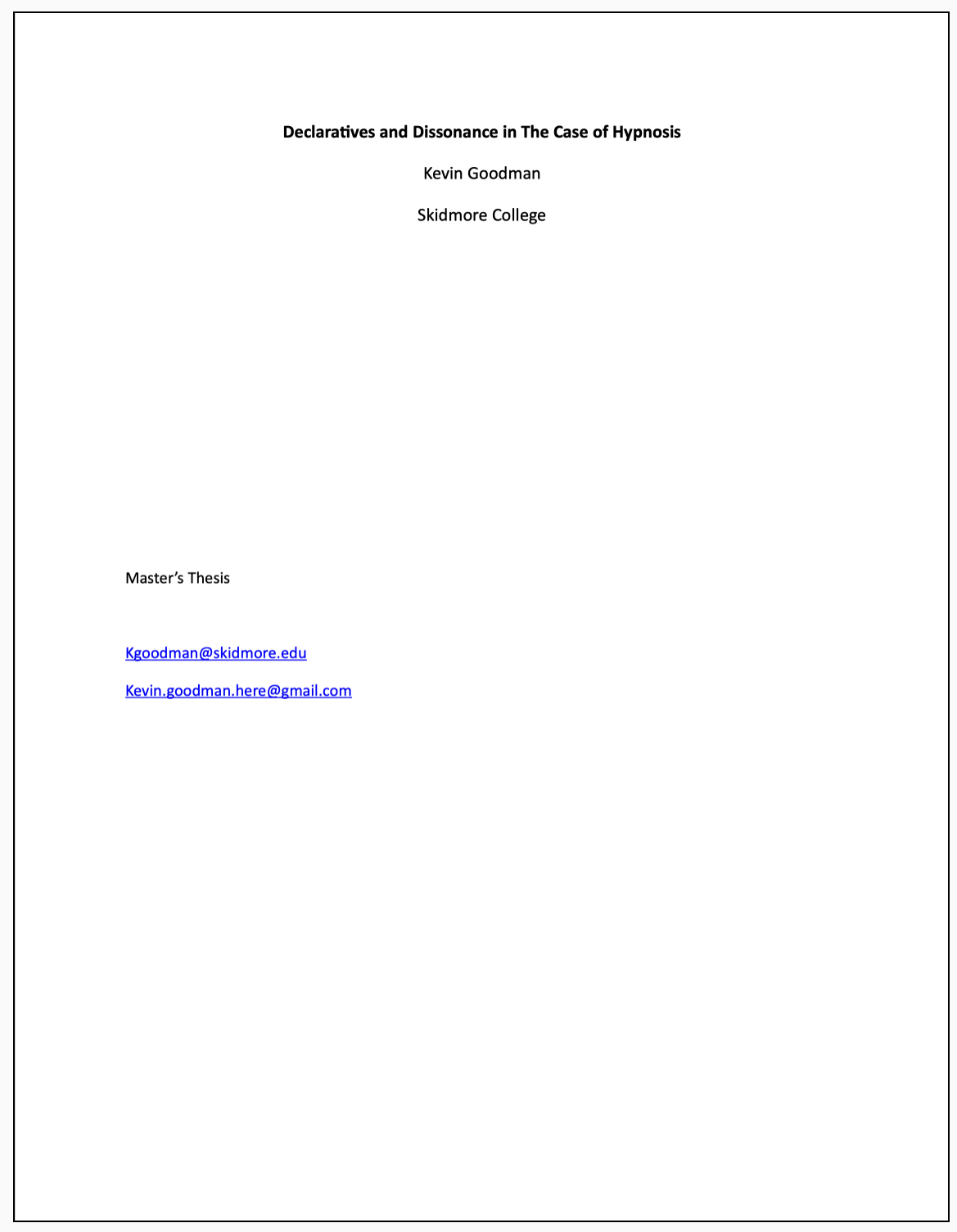
Declaratives and Dissonance in The Case of Hypnosis
Abstract
The purpose of this study is to glean some insight into the social cognitive mechanisms of the hypnotic experience; particularly of interest is how interaction between hypnotist and subject shapes the subject’s experience as both fantastical and genuine. Three instructional videos designed to instruct would-be hypnotists provide the data for this analysis. Each video features a different hypnotist offering instruction in his methods with purportedly unscripted demonstrations involving subjects in both entertainment and therapeutic contexts. The performances were transcribed using conversation-analysis notation conventions; the transcripts were then broken down into units of interaction and descriptively coded. The codes allowed for the recognition of themes within each case and for cross-case comparisons. Across all three cases there appears to be a reasonable understanding between hypnotist and subject of what the hypnotist expects, along with an implicit obligation of the subject to perform. I suggest that an implied interactional commitment exists between hypnotist and subject towards the performance. As that performance becomes counter-intuitive, an incongruence may evolve between the subject’s subjective experience and outward performance, thereby creating conditions under which cognitive dissonance could arise and be resolved in favor of the hypnotic performance. The videos do not permit direct observation of the subject’s inner state, but they reveal the recurring interactional conditions from which the mechanism is inferred. Cognitive dissonance is thus proposed as the mechanism that drives the attitudes and self-attributions of an altered state of consciousness in the case of hypnosis. What the present data cannot settle is the final step of that process, whether and under what conditions the mounting dissonance resolves into the reported phenomenology of trance; that step is offered as a claim open to experimental test.
Submitted in partial fulfillment of the requirements for the degree of Master of Arts in Liberal Studies: Cognition, Culture, and Communication at Skidmore College, 2013.
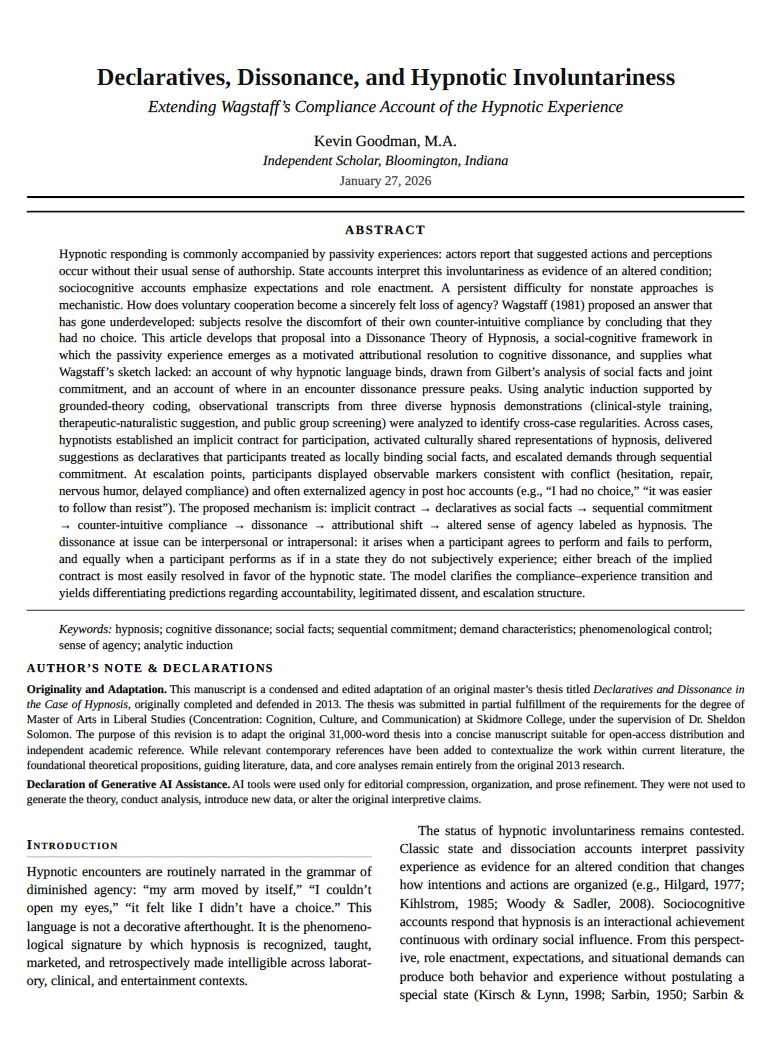
The original master’s thesis is embedded below and can be read or downloaded by clicking the cover page below. An updated and synthesized version is also available on Zenodo under the title Declaratives, Dissonance, and Hypnotic Involuntariness (clicking on the cover page will open the document in Zenodo).