The Honey Barrel Problem: Scarcity, Judgment, and the Single Barrel After Proliferation
During the 1970s and 1980s, whiskey sales plummeted in what is called the whiskey glut, a downturn that had begun in the late 1960s and would take the better part of three decades to undo. Between 1970 and 1995, U.S. per capita spirits consumption fell by nearly half (Rabobank, 2026). The major reason for this was changing consumer tastes, as a younger generation looked to differentiate itself from the customs of its parents and grandparents and found whiskey, old-fashioned and unsophisticated. Vodka cocktails became vogue—modern—and vodka itself, a spirit with almost no character of its own, carried none of the baggage. It overtook gin in 1967 and whiskey roughly nine years later, and it did so while whiskey sales were actively falling (Barton, 2025). Reid Mitenbuler (2015, as cited in Barton, 2025) puts the generational dynamic plainly, writing that bourbon “became a symbol of patriarchy and the Establishment.” Whiskey, in short, had an image problem.
Distilleries were slow to adapt and continued production but sales did not pick up—this resulted in surplus inventories on a scale that is difficult to picture; by 1980, Kentucky distilleries were making fewer than a million barrels of bourbon a year while sitting on roughly five times that amount in maturing stock (Barton, 2025). The industry’s first responses only deepened the hole, since Congress, at the industry’s urging, created a light whiskey category in 1971 which promptly flopped. Distillers, meanwhile, cut prices and proof to move what they had—a strategy which, as Michael Veach has argued, taught consumers to see bourbon as a cheap, low-quality product (Barton, 2025; Veach, 2019). The whiskey industry looked for ways to shake the stigma that had taken hold of it.
One solution arose from the George T. Stagg Distillery in Frankfort, Kentucky, the distillery we now know as Buffalo Trace. In 1984, it released Blanton’s Single Barrel, which the company still bills as the world’s first commercially available single barrel bourbon and the bottle that created the “super premium” category (Buffalo Trace Distillery, n.d.-b). The project was led by Master Distiller Elmer T. Lee, who remembered how former distillery president Colonel Albert B. Blanton handpicked “honey barrels” for himself and his VIPs (Buffalo Trace Distillery, n.d.-a). The timing was no accident; Eddie Russell of Wild Turkey has suggested that the industry learned the appeal of limited, higher-priced releases from Japan, which was buying aged American whiskey in the 1980s when Americans would not, and he counts Lee’s single barrels amongst the first products of that lesson (Barton, 2025). Bottling a single barrel was not new—distillers had always kept the good barrels for themselves and their friends—but selling the practice to the public under the name of the man who had once done the choosing was. The honey barrel, after all, was prized, not because it was scarce, but precisely because Blanton had chosen it. I will return to that distinction, since I believe the rest of this argument depends on it.
Whereas the goal of commercial production had been homogenizing for consistency, blending many hundreds or thousands of barrels per batch so that the bottle a drinker buys this year tastes like the one he or she bought last year, the single barrel was just that—the bottled whiskey of a single barrel. Individual barrels from the same distillation run can have variances in flavor from a number of factors, including but not limited to their placement in the warehouse, which in turn is affected by the climate within the warehouse, and a barrel aging on the top floor of a rickhouse will not taste like its twin on the bottom. A blender, of course, averages those variances away; the single barrel embraces the variance. Exceptional barrels could be bottled as a unique and unreplicable profile—even if subtle and nuanced—and this elevated Blanton’s Single Barrel to a sophisticated offering with scarcity built in. Each barrel represented somewhere around two hundred to two hundred and fifty bottles and no more. It is this pairing of sophistication and scarcity, I propose, that explains both the single barrel’s early success and its present trouble.
From this endeavor two new consumers emerged—one who sought to relish the subtle differences between barrels and one who was biased by the scarcity so as to collect. The first, the connoisseur, buys difference, and his or her pleasure lies in noticing that one barrel runs towards a cherry note and the other towards a leather note. The second, the collector, is moved by what Robert Cialdini (1984) called the scarcity principle, the notion that a thing grows more desirable as it becomes less available. Buffalo Trace has never been shy about courting him or her; every Blanton’s label carries its barrel’s dump date, which collectors hunt to match birthdays and anniversaries. Its eight horse-and-jockey stoppers are applied at random, which turns a bottle into a set to be completed, and the brand has become collectible enough that bottles routinely surface at auction for well above retail (Buffalo Trace Distillery, n.d.-b). The distillery’s own product page thereby stands as a testament to the second consumer as much as the first. In terms of marketing the project was successful. It succeeded because a single barrel is by definition both different and scarce, so that nobody had to ask which promise was being made.
It was only a matter of time before other distilling companies followed suit or developed competing strategies (such as the small batch). The term “small batch,” as Jeffrey Schwartz (2017) points out, carries no legal definition at all and so can describe two barrels or two hundred. In what follows, I will argue that the bundling of difference and scarcity, which was the single barrel’s great strength in 1984, has become its central weakness. The two promises no longer travel together, and when they come apart the two consumers come apart with them.
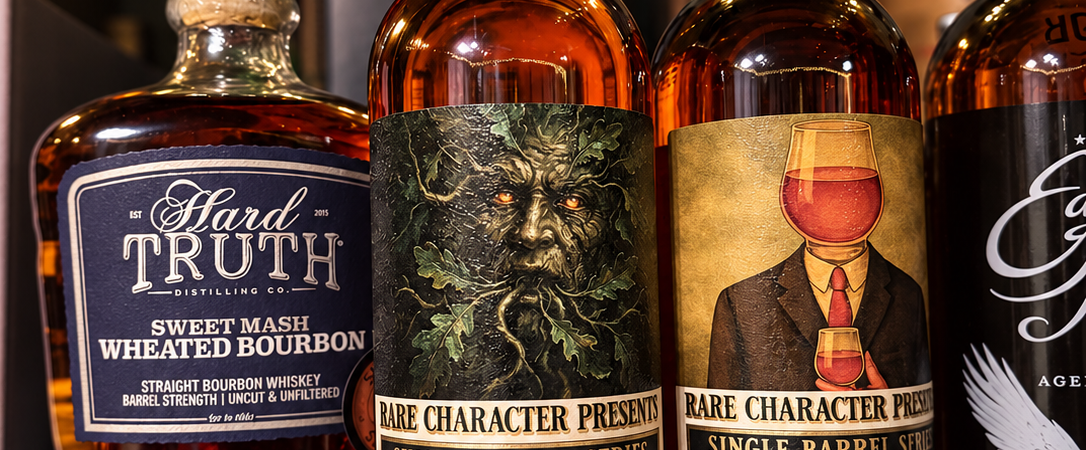
By the 1990s, the whiskey industry was beginning to rebound, and then through the first two decades of the twenty-first century a craft boom of small distilleries exploded into the market; Kentucky alone held a record 14.3 million barrels of maturing bourbon as of 2025 (Barton, 2025). And now single barrels and small batches are everywhere. Store picks—barrels chosen by a retailer, a bar, or a bourbon club and bottled under its name—have multiplied right alongside them, to the point that an endcap of hand-lettered shelf talkers has become a fixture of the American liquor store. So the question begs to be asked: is this type of differentiation still effective at triggering a bias for the unique?
The whiskey industry has found itself in a new slump. The trade talk I first heard held that premium labels were holding strong while middle tier products were seeing lower volumes, and I was prepared to restate it blindly with a disclaimer attached. The data, as it turns out, is more specific. IWSR figures show American whiskey volumes in the United States tipping into decline in 2023 and falling further through 2024, with the losses concentrated almost entirely in bottles under about $22.50; meanwhile the super-premium tier, everything above $30.50, grew by 6%, and the premium tier sandwiched between them went flat, as drinkers trading down into it were cancelled out by drinkers trading down out of it or leaving whiskey altogether (IWSR, 2024). Craft fared worse still in 2025, when craft spirits volume fell 8%, the number of active craft distillers dropped by 6.6%, and craft lost share of the total U.S. spirits market (Park Street, 2026). But the data does lead to some questions such as how premium is defined. For instance, are we talking about the allocated releases of major distilleries, or does this category include the smaller and newer craft distilleries? By IWSR’s measure it is both, since a super-premium tier beginning at thirty dollars and change lumps an allocated Blanton’s together with a seventy-dollar bottle from a two-year-old distillery. However we splice it, we can return to the fact that the single barrel was implemented as a premiumization strategy, and the question becomes which half of that strategy is still working.
So what happens when single barrels and small batches proliferate? Decision fatigue! Or, to use the more precise term, choice overload. I admit that the choice overload literature is muddier than its popularity suggests; across fifty experiments its average effect comes out close to zero (Scheibehenne, Greifeneder, & Todd, 2010). However, it does reliably appear when the options are hard to compare and the chooser has no settled preference (Chernev, Böckenholt, & Goodman, 2015), and that is about as fair a description of a whiskey aisle as I can think of. The scarcity principle, for its part, loses its heuristic value for signaling uniqueness in a sea of unique things, and here, I believe, is where the two consumers part ways. The collector was always buying scarcity, and when scarcity inflated in the middle of the market he or she simply followed it upward to the allocated tier, where it is still genuine—the lottery bottles, the bottle draws, the releases that never touch a shelf. The connoisseur was buying difference, which he or she still wants but can no longer navigate. Forty barrels each claiming a singular profile are effectively forty claims that most connoisseurs cannot afford or navigate. It is reasonable to speculate, then, that the bifurcation in the sales data is partly a story about household budgets, which it surely is, and partly a story about a signaling strategy that has lost efficacy.
Suppose, for instance, Dale walks into a liquor store in Indianapolis, Indiana, on a Friday evening with sixty dollars and a brother-in-law to impress. He finds thirty-one bottles marked single barrel, nine marked small batch, and six store picks with hand-lettered shelf talkers, and he has no way of knowing whether barrel 214 differs from barrel 388 in any way his palate could detect.
It does not matter why Dale came in; what matters is how he leaves, and it seems to me he will leave having been chosen by price, by the appeal of the label, by the familiarity and notoriety of a label he has learned to trust, or some combination of the three. This doesn’t mean the single barrel is dead or without value but rather that brands need other robust strategies to compete for consumer attention and loyalty. Of Dale’s three singular options, I suggest, only the last has anything to do with what the single barrel was originally selling.
We live in a world that seemingly favors the smaller, more intimate, more localized “craft” producer—and yet the craft producer holds a mere 4.2% of the American spirits market by volume (Park Street, 2026). Ironically, the large distilleries are simultaneously both big business and culturally situated to dominate perceptions of authenticity, in that they are mythologized by cultural and historical narratives that span decades. If Richard Peterson (1997) is right to posit that authenticity is not found but fabricated out of whatever materials the past supplies, then the big distilleries have an enormous head start. The glut itself is part of that material, since the number of Kentucky distillers fell from roughly seventy to ten over two decades of the downturn (Rabobank, 2026), and the houses that survived now get to tell the story of having survived. In one dimension, craft is about authenticity and big business happens to own the cultural narrative in craft whiskey.
That narrative is made of people as much as time, and specifically of people whose judgment the drinker has been taught to trust. Booker Noe, Jimmy Russell, and Elmer T. Lee are characters in the story the bottle tells, and their authority rests on a long record of visible choices. Eddie Russell recalls his father refusing, from the early 1980s into the 2000s, to give up the 101-proof Wild Turkey while much of the industry was diluting its way through the glut (Barton, 2025); that refusal has likely done more for the brand’s credibility than any limited release, because it was a judgment that cost something. A craft producer cannot manufacture sixty years of heritage but it can build a named palate with a public record in a few. Note: the 2025 data hints at where that record is most readily built. More than one in four craft bottles is now sold in the distillery’s own tasting room, up from roughly one in seven a decade ago (Park Street, 2026); craft’s strongest channel is thus the one place where a drinker can meet the person who chose the barrel.
So let’s return to the point of the single barrel—mindful that there are a few points—and specifically to the one the single barrel is supposed to represent, which is that the particular barrel stands as someone’s opinion of a particularly notable or unique expression of the whiskey, the quality of which would be lost if blended. The French sociologist Lucien Karpik (2010) offers, I think, a useful vocabulary for what has gone wrong. Karpik posits that markets for singularities, goods such as wine, art, or legal counsel whose quality is uncertain and cannot be ranked on a single scale, cannot run on price alone and depend instead on judgment devices, by which he means critics, guides, rankings, appellations, and trusted names. A single barrel is a singularity in precisely Karpik’s sense, and the proliferation I have described is simply what happens when singularities multiply faster than the devices for judging them. The taster, in other words, is a judgment device. So in theory the way to elevate a single barrel program is to elevate the reputation of the taster who selects the barrel, and the same principle applies to the small batch blender.
The store pick already proves this and already threatens it. Private barrel programs exist because retailers, bars, and clubs discovered that a named selector could restore some of the signal the single barrel had lost, and the best of them take the work seriously; Schwartz (2017) describes a selection committee that tasted five Four Roses barrels double-blind, twice and in different orders, before voting. He is equally frank that some retailers take a barrel simply because they were offered one and want in on the game, sometimes without tasting it first, and that the shopper’s only reliable guide is the store’s history of picks. If every barrel carries a selector’s name, then the selector becomes one more unproven claim and Dale is back where he started. The durable scarce resource is therefore credibility, which is built by a track record, by disclosed reasoning, by a stated method, and perhaps above all by visibly rejecting barrels. A taster who never says no is not judging anything.
So far, I have argued that the single barrel bundled two promises, difference and scarcity, and that proliferation has pulled them apart, sending the collector upward towards the allocated tier and leaving the connoisseur stranded amongst differences lacking the reputation of a trusted voice. Restated, my position here is that the single barrel was always a judgment product that happened to be scarce, and once proliferation cheapened the scarcity, judgment became the only thing left worth selling. That is good news for craft, which cannot buy heritage but can earn trust, and it is a warning to anyone who believes a name on a label can stand in for a palate. Colonel Blanton never had to explain why his barrels were the good ones; his name on the choice was explanation enough, and Elmer T. Lee built an entire category on the memory of it. If everyone is now a selector, whom does the drinker trust—and what would a taster have to do to deserve it?
References
Barton, S. S. (2025, July 28). What can bourbon distillers learn from the last big bust? VinePair. https://vinepair.com/articles/bourbon-distillers-learn-from-last-big-bust/
Buffalo Trace Distillery. (n.d.-a). Albert B. Blanton. https://www.buffalotracedistillery.com/our-distillery/legendary-people/colonel-albert-blanton/
Buffalo Trace Distillery. (n.d.-b). Blanton’s Gold Edition. https://www.buffalotracedistillery.com/our-brands/blantons-single-barrel/blantons-gold-edition/
Chernev, A., Böckenholt, U., & Goodman, J. (2015). Choice overload: A conceptual review and meta-analysis. Journal of Consumer Psychology, 25(2), 333–358.
Cialdini, R. B. (1984). Influence: The psychology of persuasion.
William Morrow.IWSR. (2024, October 23). Key US states for American whiskey are softening – why?https://www.theiwsr.com/insight/key-us-states-for-american-whiskey-are-softening-why/
Karpik, L. (2010). Valuing the unique: The economics of singularities. Princeton University Press.
Mitenbuler, R. (2015). Bourbon empire: The past and future of America’s whiskey. Viking.
Park Street. (2026, October 6). Craft spirits sales account for $7.3 billion as tasting rooms take center stage. https://www.parkstreet.com/craft-spirits-sales-account-for-7-3-billion-as-tasting-rooms-take-center-stage/
Peterson, R. A. (1997). Creating country music: Fabricating authenticity. University of Chicago Press.
Rabobank. (2026, March 19). Heaven Hill on how to thrive in a downturn [Audio podcast episode]. In Liquid Assets: A beverage industry podcast. https://raboresearch-beverages.libsyn.com/heaven-hill-on-how-to-thrive-in-a-downturn
Scheibehenne, B., Greifeneder, R., & Todd, P. M. (2010). Can there ever be too many options? A meta-analytic review of choice overload. Journal of Consumer Research, 37(3), 409–425.
Schwartz, J. (2017, July 26). Store pick 101: The private barrel. Bourbon & Banter. https://www.bourbonbanter.com/store-pick-101-the-private-barrel/
Veach, M. R. (2019, September 2). Causes of bourbon’s decline in the late 1960s. Bourbonveach. https://bourbonveach.com/2019/09/02/causes-of-bourbons-decline-in-the-late-1960s/